Alcohol, Memory & Decision-Making — Part 1
BLUF
Alcohol does not erase memories. It stops them from being stored. Memory forms in stages — perception, attention, encoding, storage, retrieval — and alcohol’s signature effect is on the transfer from short-term to long-term storage. An intoxicated person can be awake, talking, and fully present, and have no record of it the next day. That failure is a “blackout,” and it can be partial (fragmentary) or complete (en bloc).
Have you ever forgotten something?
Everyone knows memory isn’t perfect. Nobody remembers their own birth, and the elderly have been forgetting things since the beginning of recorded time (and presumably before, though the records are spotty). Still, most of us walk around treating our own memory as basically reliable — a slightly scratched recording of what happened. This series is about why that assumption is wrong, why it’s especially wrong after a few drinks, and what the research actually shows. But before we get to alcohol, we need to talk about what memory is for.
Why do we remember anything at all?
Memory exists to help an organism make sense of the world well enough to survive it. A squirrel that remembers where it buried most of its nuts is more likely to make it through winter and produce many squirrel babies. An early human who remembered which berries were poisonous was more likely to make it through lunch.
Notice the word most. Evolution has a habit of building things that work just well enough to give the next generation an edge, and then stopping. Remembering where 50% of your nuts are gets you through winter. Remembering 100% costs a great deal of extra brain, and brains are expensive — yours burns about a fifth of your calories while sitting still. The returns on perfect recall diminish fast, so no animal has it. Until everyone is issued a 24/7 implanted camera at birth, we’re stuck relying on the lump of mush between our ears, which is, through natural selection, merely good enough.
“Good enough” is a perfectly reasonable standard for a squirrel. It’s a much shakier standard for a witness.

The kinds of memory
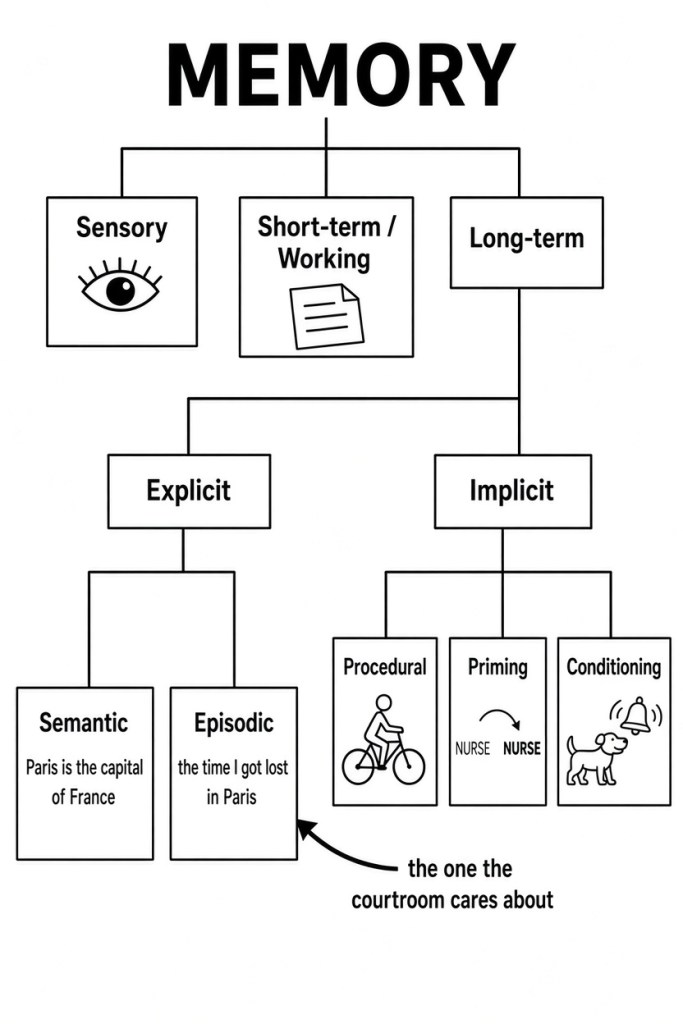
“Memory” is not one thing. Psychologists describe it as a set of stores that hold information for different lengths of time, feeding into one another, and a set of long-term systems that hold different kinds of information on different hardware.
Sensory memory is the buffer that holds raw sensation for a fraction of a second after it arrives. For vision this iconic memory lasts about a quarter of a second; for hearing, echoic memory lasts up to a few seconds.1 It’s the reason a sparkler traces a line in the dark even though it’s only ever at one point. Its capacity is enormous — essentially everything hitting your senses — and nearly all of it is discarded before you’re aware of it.
Short-term memory is what survives that first cut: the small amount of information you’re currently holding in mind. Its capacity is famously limited to about seven items, give or take two,2 and without active effort it decays in seconds — in the classic experiment, people who were prevented from rehearsing a three-letter string had lost most of it within about eighteen seconds.3 With attention and rehearsal, though, information can be kept alive for several minutes. That active maintenance and manipulation is what psychologists call working memory,4 and it’s the mental workspace you use to hold a phone number until you dial it, keep the first half of a sentence in mind while you hear the second, or track where you are in a conversation.
Long-term memory is everything that lasts beyond that window — hours, days, years, a lifetime — and it has no known capacity limit. Information moves from sensory to short-term to long-term storage in stages, in a model psychologists have used in one form or another since the 1960s.5 Long-term memory then splits by kind:6
- Explicit (or declarative) memory is what you can consciously call up and put into words. It includes semantic memory — facts and concepts, like the capital of France or the elements of a criminal offense — and episodic memory — events you personally lived through, tagged with a time and a place. Your own life story, assembled from episodic memories, is autobiographical memory.
- Implicit (or non-declarative) memory shapes your behavior without your being able to describe it. Procedural memory — riding a bike, typing, tying a boot — is the main kind, and the reason you can tie a bowline without being able to explain the sequence. Implicit memory also includes priming (recent exposure to something makes it easier to recognize) and the learned associations of classical conditioning (the dog salivating at the bell).
In criminal justice we are almost always interested in one specific branch of this tree: long-term, explicit, episodic, autobiographical memory. What happened, to me, that night. That is the memory a witness is drawing on. It is the one alcohol damages most selectively, and it is the one this series is about.
How we know memory works this way
If you have ever disagreed with a friend (or enemy) about how an event went down, you already know your memory can be wrong. But more likely it’s the other guy who is mistaken, right?
Scientists have been studying human memory systematically for well over a century, since Hermann Ebbinghaus sat alone in a room in the 1880s memorizing lists of nonsense syllables and charting how fast he forgot them. (His forgetting curve, incidentally, replicates beautifully when modern researchers repeat the experiment.7) Through a great many clever experiments since, they have worked out how a memory gets made.
The model below describes the ideal — memory working the way it’s designed to. Every stage in it has known failure modes, and much of this series is about those failures: not only memories that are lost, but memories that are altered, and memories that were never true in the first place. Keep in mind as you read that a memory can be missing at the end because something went wrong at any point along the way, and that a memory being present at the end is not proof that every stage went right.
There are three stages — encoding, storage, and retrieval — plus two things that have to happen before the first stage can start.
Precondition 1: Perception
For an event in the world to be remembered, some trace of it has to reach the nervous system: light has to reach the retina, sound the eardrum, a touch the skin, a chemical the lining of the nose or the tongue.
But here is a strange and important corollary. What memory records is not the world. It’s your perception of the world. The memory system doesn’t get a separate feed from reality; it gets whatever the perceptual system hands it, and it files a vivid hallucination the same way it files a vivid conversation.
Everyone has had some experience with this. Think about dreaming. You lie still with your eyes closed and hallucinate for a couple of hours. Occasionally you then wake up remembering the perceptions from those hallucinations in detail — the faces, the rooms, the sense that it was obviously real. The memory of the dream is a memory of something that never happened, formed by exactly the same process as a memory of breakfast. Sorting out afterward which memories came from the outside world and which came from inside your own head is a separate mental job that psychologists call source monitoring, and it fails more often than people expect, in perfectly healthy brains.8
An aside on smell. Every sense but one routes through the thalamus, a relay station in the middle of the brain that filters and sorts incoming signals before they reach the cortex. Smell is the exception. The olfactory bulb projects almost directly into the amygdala (emotion) and the hippocampus and its neighbors (memory), with no thalamic checkpoint on the way.9 That anatomical shortcut is the leading explanation for why a whiff of a particular cologne or floor cleaner can drop you into a moment from twenty years ago with an emotional force that a photograph of the same moment doesn’t carry. Brain imaging bears this out: memories cued by an odor produce stronger amygdala activation than the same memories cued by a picture.10
Precondition 2: You have to notice it
Assuming you have skin and are wearing clothes, you should be able to feel your clothes on your skin. You almost certainly weren’t feeling them a moment ago, before that sentence. The sensation was arriving the whole time; your nervous system was filtering it out because it wasn’t changing and wasn’t important. The moment a tag starts to itch, it gets through.
That filtering — attention, or monitoring — is the second precondition, and it’s the real bottleneck. Your senses take in vastly more than your brain can process, and only what gets attended to has any chance of being remembered. The reason you can’t recall the license plate of the car that hit you is usually not trauma. It’s that you were paying attention to the car, not the plate. For a fun example, here is a simple self-guided memory test:
The most famous demonstration of this involves a gorilla. In 1999, Daniel Simons and Christopher Chabris made a short video of two teams passing basketballs and asked viewers to count the passes made by the team in white. Partway through, a person in a full gorilla suit walks into the middle of the frame, faces the camera, thumps its chest, and walks off. It’s on screen for about nine seconds. Roughly half the viewers never saw it.11 They were looking straight at it; they were busy counting. Consciously attending to one thing makes it dramatically easier to miss everything else — and you cannot remember what you never noticed.
This is one reason a witness could have looked directly at something and have no memory of it. It is not the only reason. In an adversarial proceeding, credibility is always in play, and people do sometimes just lie; a claimed failure to remember something important can be exactly what it looks like. The science says only that inattention is a real and common alternative, not that it’s the explanation in any particular case.
This filtering also isn’t the same in all people. Many people on the autism spectrum report that ordinary sensations — clothing textures, fluorescent hum, the seam of a sock — are intolerable. Brain-imaging work supports the mechanism: autistic youth with sensory over-responsivity showed stronger responses in the amygdala and primary sensory cortex to mildly unpleasant sounds and touch, and those responses failed to fade with repetition the way they did in typically developing kids.12 Their brains weren’t turning the constant input down.13 The tag never stops itching.
Stage 1: Encoding
Encoding is the step where your brain receives, perceives, and converts incoming sensory information into a usable code — a format the nervous system can store and work with. It’s where the raw feed of sight and sound and touch becomes an event: this person, saying this, in this room.
What gets encoded is the perception, not the thing itself. That sounds like a technicality, but it’s the hinge on which much of this series turns. Perception at the moment of encoding is shaped by attention, by expectation, by emotion, by what you were told a minute earlier, and by what’s in your bloodstream. Two people in the same room can encode the same event in dramatically different ways, and each will remember theirs. Part 5 of this series goes into the specific ways this happens.
Encoding starts in short-term memory, which holds a newly perceived event for seconds to a few minutes while you decide, mostly subconsciously, what to do with it. This window is what lets you maintain a train of thought, follow a conversation, and find your way across a room without re-evaluating every object in it; it’s the working surface for navigating the world, socially and physically. The vast majority of what passes through it is never kept. Some of it gets transferred to long-term storage, and the structure that does the transferring is the hippocampus, a seahorse-shaped strip of cortex tucked into each temporal lobe.
We know short-term and long-term memory are separate systems because of what happens when the hippocampus is removed and everything else is left in place. In 1953 a surgeon named William Scoville removed the medial temporal lobes of a young man with intractable epilepsy, known for the rest of his life only as H.M. The seizures improved. His short-term memory was intact — he could hold a conversation, repeat a string of digits, do arithmetic in his head. His intelligence was unchanged, and his memories from before the surgery were largely preserved. But for the remaining 55 years of his life he formed almost no new long-term memories. He met the same researchers hundreds of times as strangers.14 The transfer had been cut.
Stage 2: Storage
Storage is the maintenance of encoded information over time. It isn’t a single act of filing; a new memory is fragile for hours to days after encoding, and during that period it is consolidated — strengthened, reorganized, and connected to what you already know.
The hippocampus is central to the early part of this, which is why the question “is the hippocampus for encoding or for storage?” doesn’t have a clean answer: it does both, for a while. Newly formed episodic memories depend on it heavily. Over weeks to years, through a process called systems consolidation, the memory becomes progressively more dependent on distributed networks in the neocortex and less on the hippocampus.15 That’s why H.M. kept his childhood but couldn’t form a new memory of lunch: old memories had already moved out of the hippocampus; new ones had nowhere to start.
A large share of consolidation happens during sleep. Across a night, the hippocampus appears to replay the day’s experiences to the cortex, and interfering with sleep after learning measurably weakens what gets retained.16 Anything else that disrupts the hours after an event can weaken a memory that was initially encoded well — and, as Part 4 of this series covers, the cellular process that consolidation depends on turns out to be sensitive to remarkably small amounts of alcohol.
Even a well-consolidated memory is not a fixed record. Every time it’s retrieved it becomes briefly unstable again, and has to be re-stored — with whatever changes that retrieval introduced. That’s the subject of Part 5 of this series.
Stage 3: Retrieval
Retrieval is bringing stored information back into awareness. It comes in several forms, and they’re not equally reliable. Recognition — “have you seen this face before?” — is the easiest, because the thing itself is in front of you as a cue. Cued recall — “what was the name of the man at the bar?” — is harder. Free recall — “tell me what happened that night” — is hardest of all, because nothing outside your own head is helping.
The word that matters here is reconstruction. Retrieval is not playback. The brain does not store an event like a computer might store a single file; it stores fragments, distributed across many regions, and reassembles them on demand. The reassembly is guided by what you expect an event like that to contain, what you’ve heard about it since, how you feel about yourself, and how the question was asked. Most of the time this works well enough — remember the squirrel — and the reconstruction is close to what happened. Sometimes it isn’t, and the person retrieving it has no way to tell the difference from the inside. A reconstructed memory feels exactly like a replayed one.
This is the stage at which memories change, and it is where most of the science that matters in a courtroom lives. Parts 5 and 6 of this series are about it: how memories drift with every retelling, how the wording of a question can rewrite the answer, and how normal, honest, sober people can come to remember in detail things that never happened.
What alcohol does
It is said that if psychoactive drugs were tools, alcohol would be a sledgehammer.17 Very few cognitive faculties escape its effects. But the damage isn’t even. At the doses people actually drink, perception and attention narrow gradually (Part 10 of this series is about that narrowing). Encoding into long-term memory falls off a cliff.
Mankind has known for thousands of years that if you drink enough, you won’t remember the previous night. The difference between science and just goofing around is writing things down, so in 1970 Donald Goodwin and colleagues at Washington University in St. Louis did. They recruited ten men — most of them alcoholics, half with a history of blackouts — and had them drink roughly a pint of 86-proof bourbon over four hours. Starting an hour in, the researchers showed them a series of things worth remembering (children’s toys; scenes from erotic films) and asked them to recall the details two minutes later, thirty minutes later, and the next day. At two minutes, nearly everyone could describe what they’d seen. At thirty minutes and the next day, half of them had nothing: no recollection of the toys, the films, or of having been shown anything at all.18
That’s the pattern that matters. Alcohol doesn’t do much to short-term memory. The men perceived the toys, attended to them, held them in mind, and could talk about them for a couple of minutes — the memory formed. It simply never made it into long-term storage. Alcohol had produced a temporary, chemical version of H.M.

The most careful modern version of this experiment was run in 2005 by Söderlund and colleagues, with Endel Tulving — one of the founders of memory science — as senior author.19 Sixty-four men came to the lab for a nine-hour session. Everyone drank three peppermint-lemonade drinks over ninety minutes. For half of them the drinks contained a dose of ethanol that took them to a peak blood alcohol concentration of about 0.08%; for the other half, the same mix with a few drops of alcohol floated on top so it smelled right. Nobody was told which group they were in, and the placebo group’s ratings of how “high” they felt confirmed the disguise mostly worked. Throughout the day — before drinking, on the way up, at the peak, on the way down, and after sobering — participants studied new material: word pairs, photographs, word fragments, word lists.
Then, a week later, they came back and did the whole drinking day again, and this time were tested on what they’d studied the week before. Because study and test were separated by a week, and because each was done at every point on the blood alcohol curve, the researchers could tell two failures apart. If material studied while intoxicated was poorly remembered a week later no matter what state the person was tested in, the memory had never been properly stored — an encoding failure. If material studied sober was poorly remembered only when the person was tested drunk, the memory was there but couldn’t be reached — a retrieval failure.
The result was lopsided. Alcohol impaired encoding across the board: word pairs, word lists, fragments, whether blood alcohol was rising or falling. It impaired retrieval only slightly — for one task, and only while blood alcohol was climbing. What had been studied sober was still there and could be found. What had been studied drunk was largely never stored.
So a drunk person’s memory problem is mostly not that they forgot. The memory was never written into long-term storage in the first place. And a memory that was never written down cannot be recovered — not by therapy, not by hypnosis, not by trying harder, and not by the well-meaning pressure of an investigator. (Part 6 of this series is about what happens when people try anyway.)
So what is a blackout?
If you’ve seen The Hangover, or listened to a friend explain that they “blacked out” on Saturday, it can be hard to know what’s actually being claimed. Sometimes it means “I was very drunk.” Sometimes it means “I don’t want to discuss it.” Here is what the science means by it.
A blackout is a period of amnesia for events that occurred while a person was awake, conscious, and drinking. Roughly half of all drinkers report having had at least one.20 They come in two documented types, and the distinction has been tested rather than just asserted. An en bloc blackout is total: a block of time is gone and does not come back, even with cues. A fragmentary blackout (a “brownout,” if you’re under thirty) is patchy: pieces are missing, other pieces are present, and some of the missing ones return when someone reminds you. Miller and colleagues combined structured surveys with in-depth interviews of heavy-drinking young adults and found the two types are real, distinguishable categories that sit on a continuum of severity.21 Part 2 of this series looks at what a person in a blackout can and can’t do, and at whether anyone can tell it’s happening.
A blackout is temporary. Drink heavily enough for long enough, though, and the damage can become permanent. Chronic alcohol use depletes thiamine (vitamin B1), and severe thiamine deficiency injures the very structures the memory system runs on — the mammillary bodies and parts of the thalamus that sit on the hippocampal circuit. The acute phase, Wernicke’s encephalopathy, is a medical emergency: confusion, unsteady gait, abnormal eye movements. If it’s missed or undertreated, it can progress to Korsakoff syndrome, a lasting inability to form new long-term memories — in effect, a permanent blackout — often accompanied by confabulation, in which the person fills the gaps with sincere, detailed, and entirely false accounts of what they’ve been doing.22 Korsakoff patients are where the word “confabulation” comes from, and Part 6 of this series is about why healthy people do a milder version of it under pressure.
Where this series goes from here
Memory works in stages: something has to be perceived, then attended to, then encoded, then stored, then retrieved. Alcohol’s signature effect is on encoding — the transfer from short-term to long-term storage — which is why a person can be awake, talking, and entirely present in the moment, and have no record of it the next day.
That fact turns out to be the starting point rather than the end. The posts that follow take up, in order: what a person in a blackout can still do, and why it’s impossible to tell from the outside that one is happening; what alcohol does to sexual decision-making; how much you have to drink, and how fast, before memory starts to fail; why every memory changes each time it’s retrieved; how honest people come to remember things that never happened; why a blood alcohol number tells you less about a person than you’d think; why vomiting isn’t a drunkenness meter; how psychiatrists decide whether someone is able to make a decision; and what “alcohol myopia” means for the decisions intoxicated people make.
About the author
Christopher A. Jorgensen, M.D. is a board-certified forensic psychiatrist and an active-duty U.S. Air Force officer. He received his M.D. from the Uniformed Services University, completed residency in general psychiatry at the San Antonio Military Medical Center, and completed a fellowship in forensic psychiatry at the Center for Forensic Behavioral Sciences. He serves as medical director of the mental health clinic at Peterson Space Force Base in Colorado Springs and, through Jorgensen Forensic Consulting, PLLC, provides expert consultation and testimony in courts-martial and other military justice proceedings. Contact Dr. Jorgensen
References
- Sperling G. The information available in brief visual presentations. Psychological Monographs: General and Applied. 1960;74(11):1–29. https://doi.org/10.1037/h0093759
- Miller GA. The magical number seven, plus or minus two: some limits on our capacity for processing information. Psychological Review. 1956;63(2):81–97. https://doi.org/10.1037/h0043158
- Peterson LR, Peterson MJ. Short-term retention of individual verbal items. Journal of Experimental Psychology. 1959;58(3):193–198. https://doi.org/10.1037/h0049234
- Baddeley A. Working memory: looking back and looking forward. Nature Reviews Neuroscience. 2003;4:829–839. https://doi.org/10.1038/nrn1201
- Atkinson RC, Shiffrin RM. Human memory: a proposed system and its control processes. Psychology of Learning and Motivation. 1968;2:89–195. https://doi.org/10.1016/S0079-7421(08)60422-3
- Squire LR. Memory systems of the brain: a brief history and current perspective. Neurobiology of Learning and Memory. 2004;82(3):171–177. https://doi.org/10.1016/j.nlm.2004.06.005
- Murre JMJ, Dros J. Replication and analysis of Ebbinghaus’ forgetting curve. PLoS ONE. 2015;10(7):e0120644. https://doi.org/10.1371/journal.pone.0120644
- Johnson MK, Hashtroudi S, Lindsay DS. Source monitoring. Psychological Bulletin. 1993;114(1):3–28. https://doi.org/10.1037/0033-2909.114.1.3
- Saive AL, Royet JP, Plailly J. A review on the neural bases of episodic odor memory: from laboratory-based to autobiographical approaches. Frontiers in Behavioral Neuroscience. 2014;8:240. https://doi.org/10.3389/fnbeh.2014.00240
- Herz RS, Eliassen J, Beland S, Souza T. Neuroimaging evidence for the emotional potency of odor-evoked memory. Neuropsychologia. 2004;42(3):371–378. https://doi.org/10.1016/j.neuropsychologia.2003.08.009
- Simons DJ, Chabris CF. Gorillas in our midst: sustained inattentional blindness for dynamic events. Perception. 1999;28(9):1059–1074. https://doi.org/10.1068/p281059
- Green SA, Hernandez L, Tottenham N, Krasileva K, Bookheimer SY, Dapretto M. Neurobiology of sensory overresponsivity in youth with autism spectrum disorders. JAMA Psychiatry. 2015;72(8):778–786. https://doi.org/10.1001/jamapsychiatry.2015.0737
- Robertson CE, Baron-Cohen S. Sensory perception in autism. Nature Reviews Neuroscience. 2017;18:671–684. https://doi.org/10.1038/nrn.2017.112
- Scoville WB, Milner B. Loss of recent memory after bilateral hippocampal lesions. Journal of Neurology, Neurosurgery & Psychiatry. 1957;20(1):11–21. https://doi.org/10.1136/jnnp.20.1.11
- Frankland PW, Bontempi B. The organization of recent and remote memories. Nature Reviews Neuroscience. 2005;6:119–130. https://doi.org/10.1038/nrn1607
- Rasch B, Born J. About sleep’s role in memory. Physiological Reviews. 2013;93(2):681–766. https://doi.org/10.1152/physrev.00032.2012
- White AM. What happened? Alcohol, memory blackouts, and the brain. Alcohol Research & Health. 2003;27(2):186–196. https://pubmed.ncbi.nlm.nih.gov/15303630/
- Goodwin DW, Othmer E, Halikas JA, Freemon F. Loss of short term memory as a predictor of the alcoholic “blackout.” Nature. 1970;227:201–202. https://www.nature.com/articles/227201a0
- Söderlund H, Parker ES, Schwartz BL, Tulving E. Memory encoding and retrieval on the ascending and descending limbs of the blood alcohol concentration curve. Psychopharmacology. 2005;182:305–317. https://doi.org/10.1007/s00213-005-0096-2
- Wetherill RR, Fromme K. Alcohol-induced blackouts: a review of recent clinical research with practical implications and recommendations for future studies. Alcoholism: Clinical and Experimental Research. 2016;40(5):922–935. https://doi.org/10.1111/acer.13051
- Miller MB, et al. Distinctions in alcohol-induced memory impairment: a mixed methods study of en bloc versus fragmentary blackouts. Alcoholism: Clinical and Experimental Research. 2018;42(10):2000–2010. https://doi.org/10.1111/acer.13850
- Kopelman MD, Thomson AD, Guerrini I, Marshall EJ. The Korsakoff syndrome: clinical aspects, psychology and treatment. Alcohol and Alcoholism. 2009;44(2):148–154. https://doi.org/10.1093/alcalc/agn118