Alcohol, Memory & Decision-Making — Part 2
BLUF
“Passed out” and “blacked out” get used as synonyms. They aren’t. A person who has passed out is unconscious (in a stupor bordering on coma), and obviously so to everyone in the room. A person in a blackout is awake, talking, and acting; the only thing that has stopped is the recording, and nobody watching can see it. What they share is that neither person will remember any of it.
Have you ever seen The Hangover? It’s the 2009 comedy about a bachelor party in Las Vegas. The guys drink too much, wake up in a trashed hotel suite with a tiger in the bathroom and a baby in the closet, and spend the movie retracing their steps to find the groom. Most people would say they got “blackout drunk” the night before. (I mentioned this movie in Part 1 of this series and I’m going to keep mentioning it, because it is the single most-watched piece of blackout education in the English-speaking world and it gets the science about half right.)
Have you ever gotten so drunk that you forgot what happened the previous night? Across the studies that have asked, roughly half of drinkers report at least one blackout in their lifetime.1 In a survey of 772 undergraduates, 51% of those who had ever had a drink reported a blackout at some point, and 40% reported one in the previous year.2 In a sample of 3,292 Australian adults, 53% had blacked out and 56% had passed out at least once.3 Some people call it a rite of passage. Others might just call you an alcoholic. Both are getting ahead of the evidence.
Now a completely hypothetical scenario. Have you ever been at a party just after finals and seen someone who appears to be asleep after some celebratory drinking? How would you describe that person? Blacked out? Passed out? In everyday speech the two phrases get used interchangeably, and in a courtroom that is a problem, because they describe different things, and only one of them can be seen. This post is about the difference.
Two different failures
Pretend it is 1863 and you have unfortunately come down with a case of acute lead poisoning… in the form of a musket ball through your right shin… The limb has to come off below the knee or you will die of infection. Would you rather be unconscious for the procedure, or awake for all of it and simply not remember it afterward?

Anesthesiologists have a saying, “pain not remembered is pain not felt.” I’d humbly disagree. If it were my leg, I would want to be unconscious, not merely amnesic. The distinction between those two conditions is the whole difference between passing out and blacking out.
Passing out is loss of consciousness. “Unconscious” here means what a clinician means by it: a stupor bordering on coma. The person cannot be roused by their name, by shaking, or sometimes by pain. They aren’t doing anything, so there is nothing to remember, and nobody watching would mistake them for awake.
Blacking out is loss of memory formation while conscious. The person is awake, walking, talking, texting, arguing, driving, or having sex. Their senses and muscles work. What has stopped working is the transfer from short-term to long-term memory that Part 1 of this series described. The hippocampus is no longer turning “what’s happening now” into “what happened.” From the outside they look like a drunk person who is awake, because that is exactly what they are.
These are not opposites, and they are not an either/or. The blood alcohol concentration it takes to produce unconsciousness is well above the level at which most people’s memory has already quit, so a person who has passed out from drinking has, almost always, blacked out first. Memory fails first; consciousness fails later. What the two states share is that neither one lays down new memories. We don’t remember being asleep, and we only occasionally remember dreaming, so the passed-out person wakes with the same blank the blacked-out person does. The difference is what was happening during the blank, and whether anyone could see it.
Passing out: alcohol as an anesthetic
Alcohol is a general anesthetic. That isn’t a metaphor. Ethanol meets the formal pharmacological definition: at a high enough concentration it abolishes movement in response to a painful stimulus. Anesthesiologists have even measured its potency in the laboratory the same way they measure sevoflurane’s.4 Its anesthetic properties were known before ether’s were, and it has been used to provide surgical anesthesia in humans probably since prehistoric times. The reason it was abandoned the moment anything better came along is that the dose that anesthetizes is uncomfortably close to the dose that kills.
The best-known map of how alcohol’s effects stack up with rising blood alcohol is the Dubowski table, first published in 1957 and revised by its author through 2012.5 Its most recent version lists seven stages:
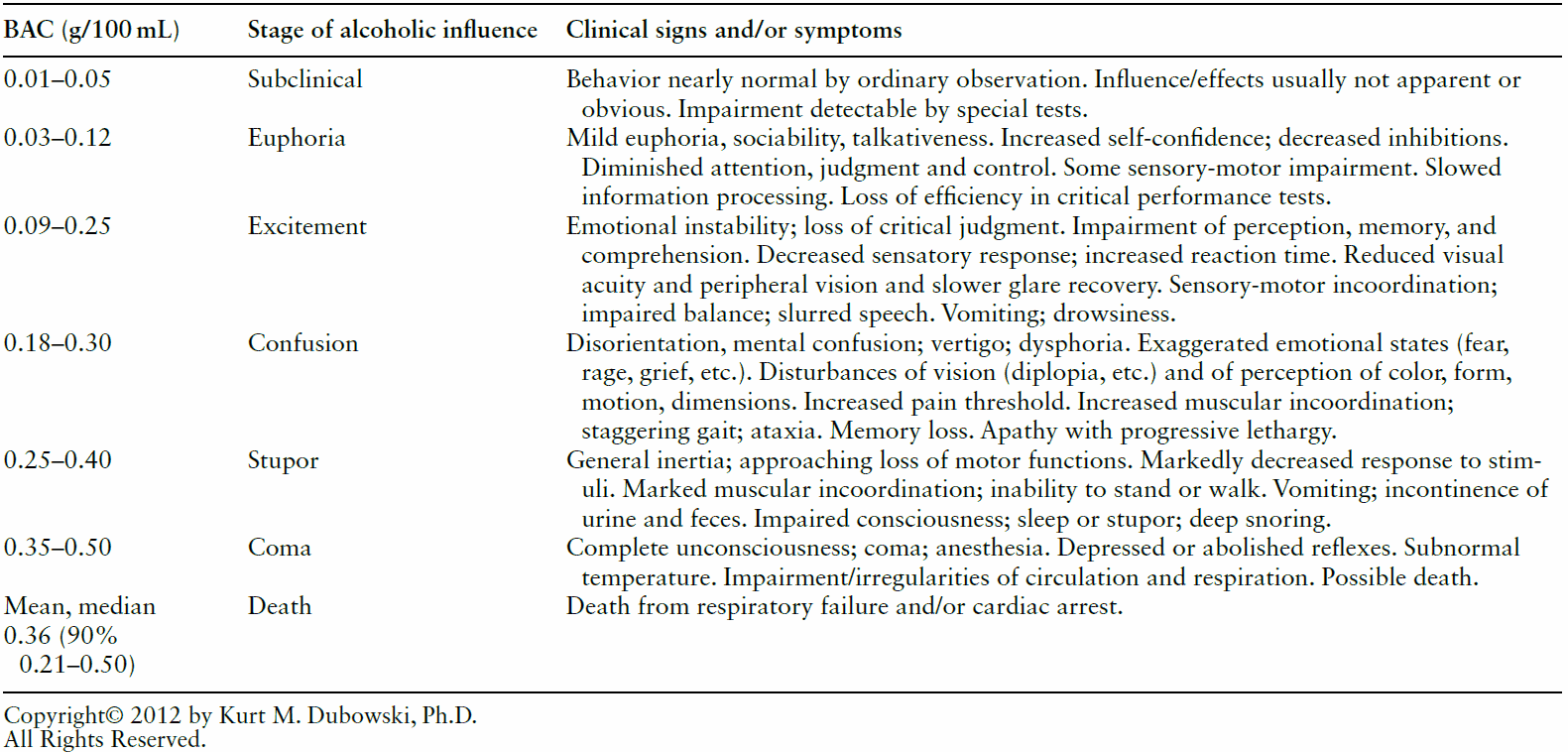
The ones that matter for this discussion are the bottom three:
- Stupor (0.25–0.40%): “General inertia; approaching loss of motor functions. Markedly decreased response to stimuli. Marked muscular incoordination; inability to stand or walk. Vomiting; incontinence of urine and feces. Impaired consciousness; sleep or stupor; deep snoring.”
- Coma (0.35–0.50%): “Complete unconsciousness; coma; anesthesia. Depressed or abolished reflexes. Subnormal temperature. Impairment/irregularities of circulation and respiration. Possible death.”
- Death: mean and median blood alcohol 0.36%, with 90% of cases between 0.21% and 0.50%.
If you look closely at those ranges, you’ll notice that they overlap quite a bit. The coma band begins at 0.35%. The average fatal level is 0.36%. Dr. Dubowski built the overlap in deliberately, because people’s tolerance of alcohol varies enormously, but the main point remains that “passed out drunk” and “dead” are neighbors.
The Nordic countries have actually studied this extensively. In 98 Nordic deaths certified as accidental alcohol poisoning, the estimated peak blood alcohol concentration in uncomplicated cases averaged about 0.46%, and lower when the person was older or had taken a sedative with it.6 In 12,126 fatal alcohol poisonings from Finland’s national post-mortem database over 32 years, the median blood alcohol was 3.2 grams per kilogram — roughly 0.34% in the units Americans use. The individual cases ran from under 0.1% to over 0.6%, but the distribution had a sharp peak: more than a quarter of all 12,126 deaths fell in the single narrow band from about 0.33% to 0.37%.7
Variability cuts the other way too. A 58-year-old woman with no history of regular drinking (so presumably no tolerance) arrived at a German emergency department with a blood alcohol concentration of 0.868%, well over double the average fatal level, after drinking roughly two bottles of spirits. She was intubated, ventilated for about 22 hours, and recovered without lasting damage.8 So there is no single number at which a person passes out, any more than there is a single number at which a person dies. What is fixed is the order of the stages: a person has to pass through confusion and stupor to get to coma, and the blood alcohol concentration that produces unconsciousness is higher than the concentration that produces a blackout.
If you’re curious where your own evenings land you on the Dubowski table, I built a blood alcohol calculator for exactly this purpose.
Passed out is not asleep
You might be thinking, “What the hell is this guy talking about? I’ve had a few drinks before and then fallen asleep without losing my memory.” What an excellent question! How do you tell the difference between someone who just fell asleep and someone who drank enough that they might not wake up to protect their airway when they vomit in their sleep?
Sleep researchers have been giving people measured doses of alcohol and recording their brains overnight since the 1880s. And humans have been imbibing unmeasured doses of alcohol before bed without recording anything since the dawn of time [citation needed]. The measured version tells a consistent story.9 A drink or two before bed does what everyone believes it does: you fall asleep faster and sleep more deeply for the first half of the night. It also suppresses dreaming (REM) sleep during that first half. Then, as blood alcohol falls in the second half of the night, the bill comes due: sleep gets lighter and more fragmented, you wake more often, and the suppressed dreaming rebounds. The restorative part of the night is exactly the part alcohol takes away. (Part 1 of this series noted that sleep is when the day’s memories get consolidated; this is one reason the morning after a heavy night of drinking is so patchy even for the parts you did encode.)
At the top of the dose range, it may not be sleep at all. In 2020, researchers at the National Institute on Alcohol Abuse and Alcoholism — the NIAAA, the federal agency that funds most American alcohol research — recorded brain activity in mice across a range of alcohol doses and sorted every two seconds of the recording into awake, dreaming sleep, or non-dreaming sleep. At the highest dose, the first stretch after the alcohol couldn’t be sorted into any of those. The brain was doing something with its own electrical signature, one that looked like what anesthetic drugs do, and ordinary sleep began only after it wore off. The authors titled the paper plainly: “Sedation/anesthesia is qualitatively distinct from sleep.”10
One more thing about the ordinary sleepiness of a smaller dose: it runs through the same brain receptor that caffeine blocks. In mice, caffeine given before alcohol prevented alcohol-induced sleep altogether.11 If that sounds familiar, you may remember Four Loko: a 23.5-ounce can of 12% malt liquor with about as much caffeine as a large coffee. The caffeine didn’t make anyone less drunk. It kept them from falling asleep, which meant they kept drinking, and emergency departments started seeing what came to be called “wide-awake drunks.” In November 2010 the FDA told the manufacturers that caffeine in an alcoholic beverage was an unsafe food additive,12 and the caffeine was out of the can within weeks. Coffee does not sober anyone up. It just disables the one safety feature alcohol comes with — eventually, it makes you stop.
So the person on the couch at the party, if they got there by drinking, is somewhere on a continuum from “asleep, badly” to “sedated to the edge of anesthesia.” Either way, nobody watching would confuse them for a participant in the evening, which is the whole point of the next section.
A blackout: the failure nobody can see
Now take the same amount of alcohol and consider the person who is still standing.
Part 1 of this series explained the mechanism: at the doses people actually drink, alcohol leaves short-term memory largely intact and interrupts the transfer into long-term storage. The person perceives, attends, responds, holds a thought for a few minutes, but the record is never written.
The behaviors documented during blackouts are not subtle. When 50 undergraduates with a history of blackouts were asked what they later learned they had done during one, 78% had been unable to recall how they got home, 32% had argued or fought, 42% had engaged in sexual activity short of intercourse with someone they knew, 10% had had intercourse with someone they knew, 10% had vandalized property, and 6% had driven a car.2 The standard reviews describe people in blackouts carrying on conversations and driving long distances,13 and the NIAAA’s own summary describes blackout events “ranging from conversations to intercourse.”14
One more number from that undergraduate study belongs in every lawyer’s notebook. Asked how they found out what had happened during their most recent blackout, 94% said another person told them — and 79% of the time, that other person had been drunk too.2 Most of what anyone “knows” about their own blackout is a secondhand account from an impaired witness. Parts 5 and 6 of this series are about what happens to a memory that starts out that way.
You cannot see a blackout happening
Between the 1960s and the 1980s, several research groups did something that would not get past an ethics board today: they gave large amounts of alcohol to volunteers, mostly heavy drinkers with a history of blackouts, and watched them continuously to catch a blackout in the act. In 2013, Pressman and Caudill reviewed every empirical study of alcohol blackouts they could find, 26 in all, including nine of these induced-blackout experiments.15
The question that should occur to you is: how did the researchers know a blackout had happened? The answer is instructive. In the best-known design, from Donald Goodwin’s group at Washington University, volunteers who could “drink a pint of whiskey in a few hours” were given the whiskey. Every thirty minutes for four hours, an experimenter showed them a toy for one minute and a one-minute scene from an erotic film — chosen because the events needed to be memorable. Two minutes later, and again thirty minutes later, the subject was asked what they had just seen. The next morning they were shown 24 toys and the entire film and asked to pick out the ones from the night before. A blackout was declared when a subject could describe the toy at two minutes, could not at thirty minutes, and still could not the next morning. Half of the ten subjects met that definition; the ones who did had drunk faster and reached higher levels (about 0.28% versus 0.18%). In Ryback’s studies, observers sat with the subjects for days and took detailed notes on their behavior; one subject blacked out at 0.14% while another stayed clear at 0.33%, and the notes could not tell which was which.
Notice what every one of these methods has in common. A blackout was identified by failed recall afterward — never by anything the experimenters could see at the time. Pressman and Caudill put it this way: the studies “uniformly reported that experimenters were unable to determine when a blackout was present based on patient behavior even as the patients were directly and continuously observed.” Their overall conclusion: “No objective or scientific method to verify the presence of an alcoholic blackout while it is occurring or to confirm its presence retrospectively was identified.” There is no test. Not a blood test, not a behavior checklist, not an expert’s trained eye.

This comes up on cross-examination more often than you’d think. Counsel will ask, in the tone of someone springing a trap, “So you’re telling me I could be blackout drunk right now?” Yes. So could the judge. So could every member of the panel. I have no way of knowing, and neither does anyone else in the room, which is exactly the point.
For decades, “you can’t tell” rested on the absence of a method. In 2026, Miller and colleagues at the University of Missouri set out to build one.16 They recruited 63 young adults who reported recurrent blackouts and, for 30 days, had their phones administer a memory test every time they logged a drink: an image on screen for five seconds, then “what did you just see?” fifteen minutes later. The next morning, participants reported whether they’d blacked out.
Failing the test was strongly associated with blackout, but on the nights people failed, they reported a blackout only 39% of the time. The test was wrong more often than it was right. Passing was more informative: on nights when participants recalled every image, they reported no blackout 92% of the time. A purpose-built, phone-administered memory test, taken in the moment, could not identify who was in a blackout. A bystander at a party has no chance.
Where the two states sit on the dial
One thing the research can say with some confidence is the order in which things happen. Only one study paired measured blood alcohol with a structured memory interview. It included 65 people interviewed within six months of an alcohol-related arrest, each with a court-documented level of at least 0.08%. The probability of a complete blackout rose steadily with blood alcohol and crossed 50% at about 0.31%.17 Blackouts were reported at much lower levels too. Put that next to the Dubowski table, where “memory loss” appears under confusion at 0.18–0.30% and stupor doesn’t begin until 0.25%, and the picture is consistent: memory fails at concentrations where the person is still walking and talking, and consciousness fails a stage later.
Which means both things routinely happen in one evening, in sequence. A person can black out at 11:00, keep drinking, and pass out at 1:00. The witnesses who saw them at 11:30 saw someone awake and participative; the witnesses who saw them at 1:30 saw someone unconscious. Both are telling the truth, and neither observation tells you when the memory stopped.
Both of these failures depend on how much alcohol is in the blood, and the next post of this series is about the numbers: how much it takes, why how fast you drink matters more than how much, and why a given blood alcohol concentration can cause different levels of impairment in different people.
About the author
Christopher A. Jorgensen, M.D. is a board-certified forensic psychiatrist and an active-duty U.S. Air Force officer. He received his M.D. from the Uniformed Services University, completed residency in general psychiatry at the San Antonio Military Medical Center, and completed a fellowship in forensic psychiatry at the Center for Forensic Behavioral Sciences. He serves as medical director of the mental health clinic at Peterson Space Force Base in Colorado Springs and, through Jorgensen Forensic Consulting, PLLC, provides expert consultation and testimony in courts-martial and other military justice proceedings. Contact Dr. Jorgensen
References
- Wetherill RR, Fromme K. Alcohol-induced blackouts: a review of recent clinical research with practical implications and recommendations for future studies. Alcoholism: Clinical and Experimental Research. 2016;40(5):922–935. https://doi.org/10.1111/acer.13051
- White AM, Signer ML, Kraus CL, Swartzwelder HS. Experiential aspects of alcohol-induced blackouts among college students. American Journal of Drug and Alcohol Abuse. 2004;30(1):205–224. https://doi.org/10.1081/ADA-120029874
- Davis CN, Slutske WS, Martin NG, Agrawal A, Lynskey MT. Genetic epidemiology of liability for alcohol-induced blacking and passing out. Alcoholism: Clinical and Experimental Research. 2019;43(6):1103–1112. https://doi.org/10.1111/acer.14045
- Fang Z, Ionescu P, Chortkoff BS, et al. Anesthetic potencies of n-alkanols: results of additivity and solubility studies suggest a mechanism of action similar to that for conventional inhaled anesthetics. Anesthesia & Analgesia. 1997;84(5):1042–1048. https://pubmed.ncbi.nlm.nih.gov/?term=Fang+Ionescu+Chortkoff+1997+anesthetic+potencies+n-alkanols
- Jones AW. Dubowski’s stages of alcohol influence and clinical signs and symptoms of drunkenness in relation to a person’s blood-alcohol concentration — historical background. Journal of Analytical Toxicology. 2024;48(3):131–140. https://doi.org/10.1093/jat/bkae008
- Poikolainen K. Estimated lethal ethanol concentrations in relation to age, aspiration, and drugs. Alcoholism: Clinical and Experimental Research. 1984;8(2):223–225. https://doi.org/10.1111/j.1530-0277.1984.tb05843.x
- Kriikku P, Ojanperä I. Significant decrease in the rate of fatal alcohol poisonings in Finland validated by blood alcohol concentration statistics. Drug and Alcohol Dependence. 2020;206:107722. https://doi.org/10.1016/j.drugalcdep.2019.107722
- Malejko K, Graf H, Gahr M. Survival of very high blood alcohol concentration without consequential damage in a patient without a previous substance use disorder. Journal of Forensic Sciences. 2016;61(4). https://doi.org/10.1111/1556-4029.13082
- Ebrahim IO, Shapiro CM, Williams AJ, Fenwick PB. Alcohol and sleep I: effects on normal sleep. Alcoholism: Clinical and Experimental Research. 2013;37(4):539–549. https://doi.org/10.1111/acer.12006
- Abrahao KP, Pava MJ, Lovinger DM. Dose-dependent alcohol effects on electroencephalogram: sedation/anesthesia is qualitatively distinct from sleep. Neuropharmacology. 2020;164:107913. https://doi.org/10.1016/j.neuropharm.2019.107913
- Fang T, Dong H, Xu XH, et al. Adenosine A2A receptor mediates hypnotic effects of ethanol in mice. Scientific Reports. 2017;7:12678. https://doi.org/10.1038/s41598-017-12689-6
- U.S. Food and Drug Administration. FDA warning letters issued to four makers of caffeinated alcoholic beverages. Press release, November 17, 2010. https://web.archive.org/web/20101120000000/http://www.fda.gov/NewsEvents/Newsroom/PressAnnouncements/ucm234109.htm
- Lee H, Roh S, Kim DJ. Alcohol-induced blackout. International Journal of Environmental Research and Public Health. 2009;6(11):2783–2792. https://doi.org/10.3390/ijerph6112783
- White AM. What happened? Alcohol, memory blackouts, and the brain. Alcohol Research & Health. 2003;27(2):186–196. https://pubmed.ncbi.nlm.nih.gov/15303630/
- Pressman MR, Caudill DS. Alcohol-induced blackout as a criminal defense or mitigating factor: an evidence-based review and admissibility as scientific evidence. Journal of Forensic Sciences. 2013;58(4):932–940. https://doi.org/10.1111/1556-4029.12134
- Miller MB, Shoemaker SD, Freeman LK, Curtis AF, Merrill JE, Merkle EC. Predictive value of real-time memory tests in identifying alcohol-induced blackouts in situ. Addiction. 2026;121:2166–2175. https://doi.org/10.1111/add.70446
- Perry PJ, Argo TR, Barnett MJ, et al. The association of alcohol-induced blackouts and grayouts to blood alcohol concentrations. Journal of Forensic Sciences. 2006;51(4):896–899. https://doi.org/10.1111/j.1556-4029.2006.00161.x